Today I went into town for a coffee and to explore London’s famous Harrods. The architecture of the building is amazing and I love all the Art Nouveau and Rococo elements. I cared less about the £ 30.000,- fur coats, bags or jewellery, but it was nice to see what all the fuss is about to the rich and famous. I needed a tiny whisk so while we were walking around the Kitchen Appliance department I looked for one. Of course it was five times as much as I was willing to pay for it, about £15,- but I was just curious. It was cool to have a look around but I think I’ll stick to my regular department store…
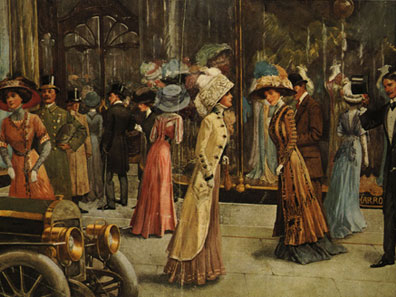
Fashion plate of 1909 shows upper-class Londoners walking in front of Harrods
Harrods was established in 1834 in London’s East End, when founder Charles Henry Harrod set up a wholesale grocery in Stepney, with a special interest in tea. In 1849, to escape the filth of the inner city and to capitalise on trade to the Great Exhibition of 1851 in nearby Hyde Park, Harrod took over a small shop in the district of Knightsbridge, on the site of the current store. Beginning in a single room employing two assistants and a messenger boy, Harrod’s son Charles Digby Harrod built the business into a thriving retail operation selling medicines, perfumes, stationery, fruit, and vegetables. Harrods rapidly expanded, acquired the adjoining buildings, and employed one hundred people by 1880.
However, the store’s booming fortunes were reversed in early December 1883, when it burnt to the ground. Remarkably, in view of this calamity, Charles Harrod fulfilled all of his commitments to his customers to make Christmas deliveries that year and made a record profit in the process. In short order, a new building was raised on the same site, and soon Harrods extended credit for the first time to its best customers, among them Oscar Wilde, legendary actresses Lilly Langtry and Ellen Terry, Noël Coward, Sigmund Freud, A. A. Milne, and many members of the British royal family.
In 1898, Harrods installed what is claimed to be the world’s first moving staircase (escalator); nervous customers were offered brandy at the top to revive them after their ‘ordeal’. © Wikipedia
The Terracotta Palace
Burbidge’s audacity was as monumental as the grand store he started building in 1901, designed by architect of Claridge’s Hotel C.W. Stephens. It was positively palatial, with a frontage clad in terracotta tiles adorned with swags, cherubs, pilasters and swirling Art Nouveau windows – and topped by a baroque dome, which still contains nothing more exciting than a water tank. Inside, the magnificent interiors included vivid Royal Doulton tiles – still in place in the Meat Hall – fine Rococo plasterwork created by Parisian craftsmen, and a vast tea room with an Art Nouveau skylight, now the Georgian Restaurant. Harrods instantly became London’s most fashionable store. In the early 1900s, writer Arnold Bennett based his novel Hugo on the store, while Harrods was recreated on the London stage in 1907 in the hugely successful musical comedy ‘Our Miss Gibbs’. With 91 departments, the store occupied just the ground and first floors of the building. Fruit and Flowers, 1927 © Harrods
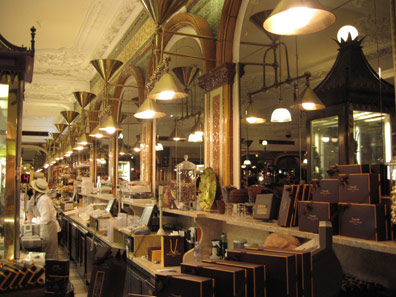
The Confectionery Department
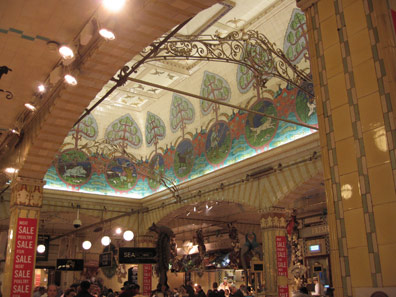
The ceiling of the Fish, Meat and Poultry Department
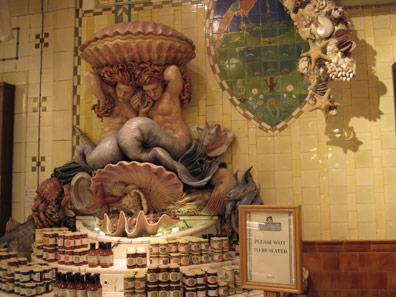
The Fish Department
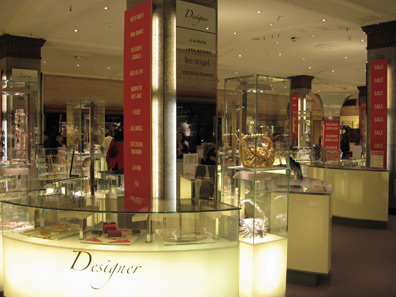
The Bag Department
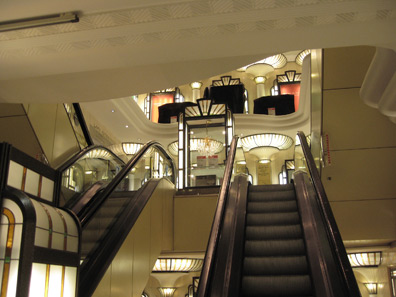
The escalators
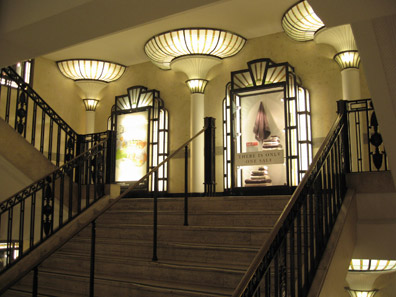
The stairs
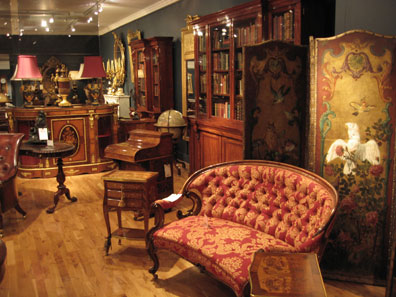
The Antiques Department
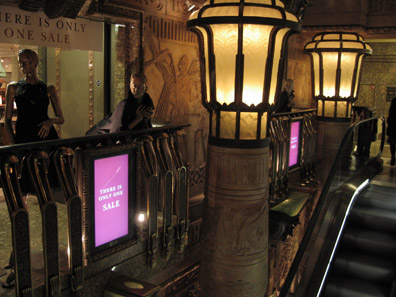
The Egyptian Hall
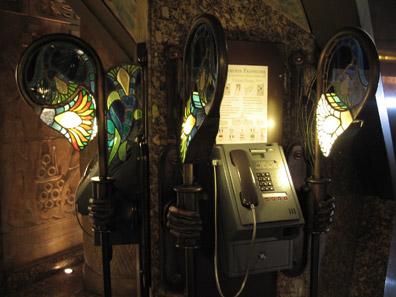
The Egyptian Hall
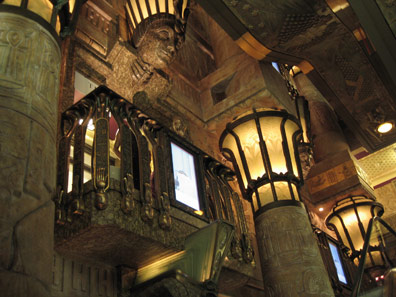
The Egyptian Hall