Hell broke loose last night [A. is on standby]. All was nice and quiet till 02.00 in the morning… Then the phone rang about every hour till about 10 before things started to become normal again. The odd phone call during the day which was okay but while writing this I prepare myself for another night of disturbance; I’ll probably have bad dreams about Teeth of Terror or CPU and data meltdowns. Could be quite an interesting night…
Monthly Archives: February 2007
Japanese Sea Dragons
These pictures below are one of many reasons why I only swim in an ‘artificially maintained area of water’… I was only five years old and in awe of nature’s wonders: constantly looking for bugs, plants or baby animals. I could walk a square metre for hours, up and down with my eyes focused on the ground in search of the tiniest plant or insect. I remember I was wandering around a forest near where my grandmother lived. There where ducklings swimming in the ditch and I was running across the wooden bridge from one side to the other and back, trying to get a good look at the tiny ducks.
At some point, one of the ducklings stayed a bit behind and out of mums sight and care, and I tried to chase it back to the group when a huge pike [Esox lucius] rose from the water with its great big jaws wide open. I had the perfect view on the row of immense teeth that snatched the little duck from the water surface in seconds, to drag it down into the deep empty black darkness of the ditch. I stood there terror-stricken, blaming myself for what just had happened to the little duck. I ran back to my grandmother’s house, screaming and crying my eyes out. I have this picture stuck in my head ever since; The Teeth of Terror…
So I relived that memory when I saw these pictures and made the same vow again as I did years ago, not to ever swim in ponds, rivers or even seas; I’m glad Japan is miles away from here…
——————————
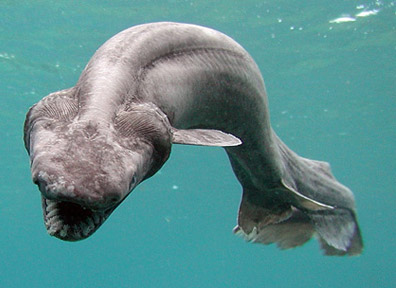
Flaring the gills that give the species its name, a frilled shark swims at Japan’s Awashima Marine Park on Sunday, January 21, 2007. Sightings of living frilled sharks are rare, because the fish generally remain thousands of feet beneath the water’s surface.
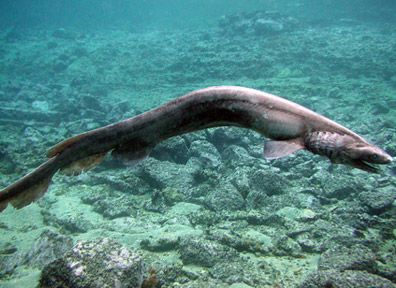
Spotted by a fisher on January 21, this 5.3-foot (160-centimeter) shark was transferred to the marine park, where it was placed in a seawater pool.
“We think it may have come to the surface because it was sick, or else it was weakened because it was in shallow waters,” a park official told the Reuters news service. But the truth may never be known, since the “living fossil” died hours after it was caught.
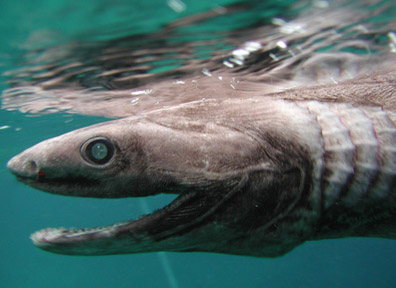
This serpentine specimen may look like a large eel, but its six slitlike gills help mark it as a cousin of the great white, the hammerhead, and other sharks. But this isn’t your average fish.
Believed to have changed little since prehistoric times, the frilled shark is linked to long-extinct species by its slinky shape and by an upper jaw that is part of its skull. Most living sharks have hinged top jaws.
With a mouthful of three-pointed teeth, the frilled shark may be a fearsome hunter, but it’s considered harmless to humans. Those needle-like choppers are better suited to fleshier forms found in the deep sea, such as squid and other sharks.
© National Geographic
——————————